Roamword: Spanish for Travel
Roamword Spanish: Latin American Spanish for travel
Roamword Spanish is a beginner course in Latin American Spanish for travellers. It runs for 180 short lesson days on a route from Ciudad de México through Central America to Buenos Aires. Lessons, phrasebook and progress work offline, the first 14 lesson days are free, and one purchase unlocks the rest.
Last updated
Coming soon to the App Store and Google Play

Who is Roamword Spanish for?
Roamword Spanish is for English speakers starting Spanish before a trip to Latin America, or picking it up again after a long gap. The first month sticks to what a traveller meets in the first days: greetings, numbers and prices, cafes, directions, restaurants, buses, rooms and small problems.
It suits travellers heading overland through Mexico and Central America, people spending a few weeks in Peru, Colombia or Argentina, and anyone who wants a phrasebook and a daily lesson that keep working with no signal on a long bus ride.
Which Spanish does it teach?
The course teaches the Spanish of Latin America rather than the Spanish of Spain. That shows up in everyday choices, such as using one plural form of "you" for everyone. In week 23 the course looks at how the language changes across the region: the informal "vos" heard in Argentina and parts of Central America, which "you" to use with whom, and how the names for everyday things change from country to country.
Where does the route go?
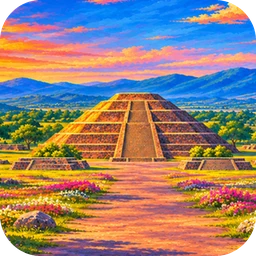
The course follows one route of real places, from Ciudad de México to Buenos Aires. Each of the 26 course weeks stops somewhere new, and each week has a painted postcard of that place that fills with colour as you complete the lesson days.
- Weeks 1 to 4: Mexico: Ciudad de México, Oaxaca, the road south and San Cristóbal.
- Weeks 5 to 12: Central America: Antigua and Lago Atitlán in Guatemala, Copán Ruinas in Honduras, Suchitoto in El Salvador, Granada and Ometepe in Nicaragua, Monteverde in Costa Rica and Ciudad de Panamá.
- Weeks 13 to 19: The Andes: Cartagena in Colombia, Quito and Cuenca in Ecuador, then Trujillo, Lima, Cusco and Machu Picchu in Peru.
- Weeks 20 to 26: The far south: Lake Titicaca and Uyuni in Bolivia, San Pedro de Atacama in Chile, Purmamarca and three weeks in Buenos Aires.
| Week | Route stop |
|---|---|
| 1 | Ciudad de México |
| 2 | Oaxaca |
| 3 | The road south |
| 4 | San Cristóbal |
| 5 | Antigua |
| 6 | Lago Atitlán |
| 7 | Copán Ruinas |
| 8 | Suchitoto |
| 9 | Granada |
| 10 | Ometepe |
| 11 | Monteverde |
| 12 | Ciudad de Panamá |
| 13 | Cartagena |
| 14 | Quito |
| 15 | Cuenca |
| 16 | Trujillo |
| 17 | Lima |
| 18 | Cusco |
| 19 | Machu Picchu |
| 20 | Copacabana / Lago Titicaca |
| 21 | Uyuni |
| 22 | San Pedro de Atacama |
| 23 | Purmamarca |
| 24 | Buenos Aires · La Boca |
| 25 | Buenos Aires · Puerto Madero |
| 26 | Buenos Aires · Centro |
What do the first 14 free lesson days cover?
The two free weeks are set in Ciudad de México and Oaxaca. The first week covers the basics of a first day in a new city; the second week moves to meals, money, taxis, buses and rooms. The lesson situations themselves are general Latin American ones, so they apply wherever your trip starts.
Week 1, Ciudad de México
- Greetings, politeness, and basic confidence. Greeting someone in a cafe or shop. You practise how to greet someone politely, say thank you, ask for slower speech.
- Introducing yourself. Meeting a local or hostel guest. You practise how to say your name, say where you are from, explain you are learning Spanish.
- Numbers, prices, and time. Asking about cost and time. You practise how to ask prices, recognise basic numbers, ask opening and closing times.
- Ordering coffee and breakfast. Ordering breakfast in a cafe. You practise how to order coffee, ask for the menu, ask for takeaway.
- Asking where things are. Finding bathrooms, ATMs, exits, and counters. You practise how to ask where essentials are, say you are lost, ask if something is near.
- Directions and getting around. Walking around a city. You practise how to ask for directions, recognise turn instructions, use a map with a local.
- Week 1 survival conversation review. A mixed survival conversation. You practise how to combine survival phrases, ask for help politely, recover from misunderstandings.
Week 2, Oaxaca
- Ordering a full meal at a restaurant. Ordering food at a Latin American restaurant. You practise how to order a full meal politely, ask the waiter for recommendations, ask for the bill.
- Dietary needs and allergies. Communicating food needs in a restaurant or market. You practise how to communicate food allergies clearly, say you are vegetarian, ask about ingredients.
- Paying, splitting, and handling money. Paying at a restaurant or market stall. You practise how to ask for the bill, pay by card or cash, request a receipt.
- Taking a taxi or rideshare. Getting into a taxi or rideshare in a Latin American city. You practise how to give a taxi driver your destination, ask about the price before getting in, tell the driver to stop.
- Buses, terminals, and tickets. Using a bus terminal in Latin America. You practise how to buy a bus ticket, ask departure times, confirm luggage allowance.
- Hotel check-in and room questions. Arriving at a hotel or hostel reception. You practise how to check into a hotel, ask about check-in time and breakfast, request luggage storage.
- Hostel and room problems. Dealing with issues in a hotel or hostel. You practise how to report a room problem, ask for a room change, speak calmly with reception.
After day 14, one purchase unlocks the rest of the 180 lesson days. There is no subscription.See every week of the course in English.
How does a lesson day work?
A lesson day is planned at about 30 minutes in the course data (28 to 40), and there is a shorter practice session for days with less time. Each day brings new phrases with English and a pronunciation guide, listening and speaking drills, a short roleplay and a checkpoint. Spaced review brings earlier phrases back when they are due. How Roamword works.
Does it work offline?
Lessons, the phrasebook and saved progress work offline. Audio playback uses an offline voice installed on your phone, and automatic speech feedback needs an on-device recognizer; without one you listen, say the phrase aloud and rate yourself.
Country notes for this route
- Mexico: languages, customs and travel notes for your Spanish route
- Guatemala: languages, customs and travel notes for your Spanish route
- Honduras: Copán, languages and travel notes for your Spanish route
- El Salvador: US dollars, customs and travel notes for your Spanish route
- Nicaragua: Granada, Ometepe and travel notes for your Spanish route
- Costa Rica: Monteverde, tipping and travel notes for your Spanish route
- Panama: the balboa, the Canal and travel notes for your Spanish route
- Colombia: languages, money and travel notes for your Spanish route
- Ecuador: languages, the US dollar and travel notes for your Spanish route
- Peru: Quechua, altitude and travel notes for your Spanish route
- Bolivia: 37 official languages, altitude and travel notes for your Spanish route
- Chile: San Pedro de Atacama, languages and travel notes for your Spanish route
- Argentina: regional Spanish, money and travel notes for your Spanish route
Questions travellers ask
- Is Roamword Spanish Latin American or European Spanish?
- Latin American. The course teaches Latin American usage, and week 23 covers how Spanish varies across the region.
- Do I need any Spanish before I start?
- No. Day 1 starts with greetings and polite basics, and every phrase comes with English and a plain pronunciation guide.
- How many lesson days are free?
- The first 14 lesson days, covering weeks 1 and 2 of the route. One purchase unlocks all 180. There is no subscription.
- Will it help in Spain?
- The travel situations are the same, and much of the course carries over, but the course teaches Latin American usage and does not cover the forms used only in Spain.
- Does it work without internet on a long bus ride?
- Lessons, the phrasebook and saved progress work offline. Audio playback uses an offline voice installed on your phone, and automatic speech feedback needs an on-device recognizer; without one you listen, say the phrase aloud and rate yourself.
Roamword: Spanish for Travel
Offline lessons, a phrasebook and speaking practice for your trip. The first 14 lesson days are free; one purchase unlocks the rest. No subscription, no account.
Coming soon to the App Store and Google Play